Humility and the Chair of
St. Peter continued
by Fr. John
Martin Shimkus, O.S.B.
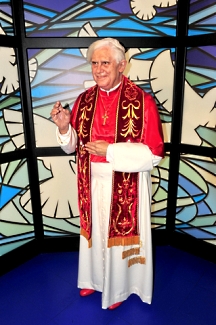 Of
course, if humility is becoming of a pope, it is
certainly becoming of each of us. Each of us
serves one another– as monk, a priest, a spouse, a
parent, an employee, a manager, or whatever other
roles we might have. Regardless of our own state
in life, if our service it is to be effective and true
to the gospel, it must also be performed in
humility. And, once again, that honest
assessment of ourselves and of the tasks assigned to
us is at the root of a humble attitude.
Of
course, if humility is becoming of a pope, it is
certainly becoming of each of us. Each of us
serves one another– as monk, a priest, a spouse, a
parent, an employee, a manager, or whatever other
roles we might have. Regardless of our own state
in life, if our service it is to be effective and true
to the gospel, it must also be performed in
humility. And, once again, that honest
assessment of ourselves and of the tasks assigned to
us is at the root of a humble attitude.
Humble servants listen to
those whom they serve and allow God to speak through
them and their needs. Humble servants are aware
of their gifts and weaknesses; they don’t pretend to
be God, but are content to do just what God has
empowered them to do. A humble servant is also
willing to admit his or her mistakes (note that St.
Peter had to do this and on more than one
occasion). Confessing our faults to one another
simply affirms part that no human being is perfect and
that God has chosen us, imperfect as we are, to share
his work of guiding and caring for his people.
Thus, embracing humility is
really one of the primary tasks of Christians – for
popes and for all followers of Jesus. Humility
requires listening, self-awareness and being honest
about our faults. It is the mark of a true
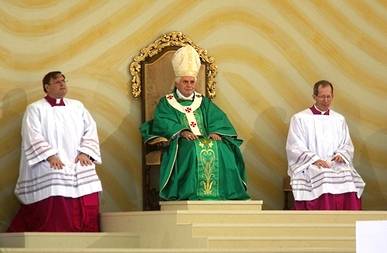
servant. I think that both St. Peter and Pope
Benedict help us to see the great value of humility,
that there is no other way to truly honor and fulfill
what God has entrusted to each of us. May we
continue to see this virtue at work in our shepherds
as we put it into practice in our own lives.
 .
.